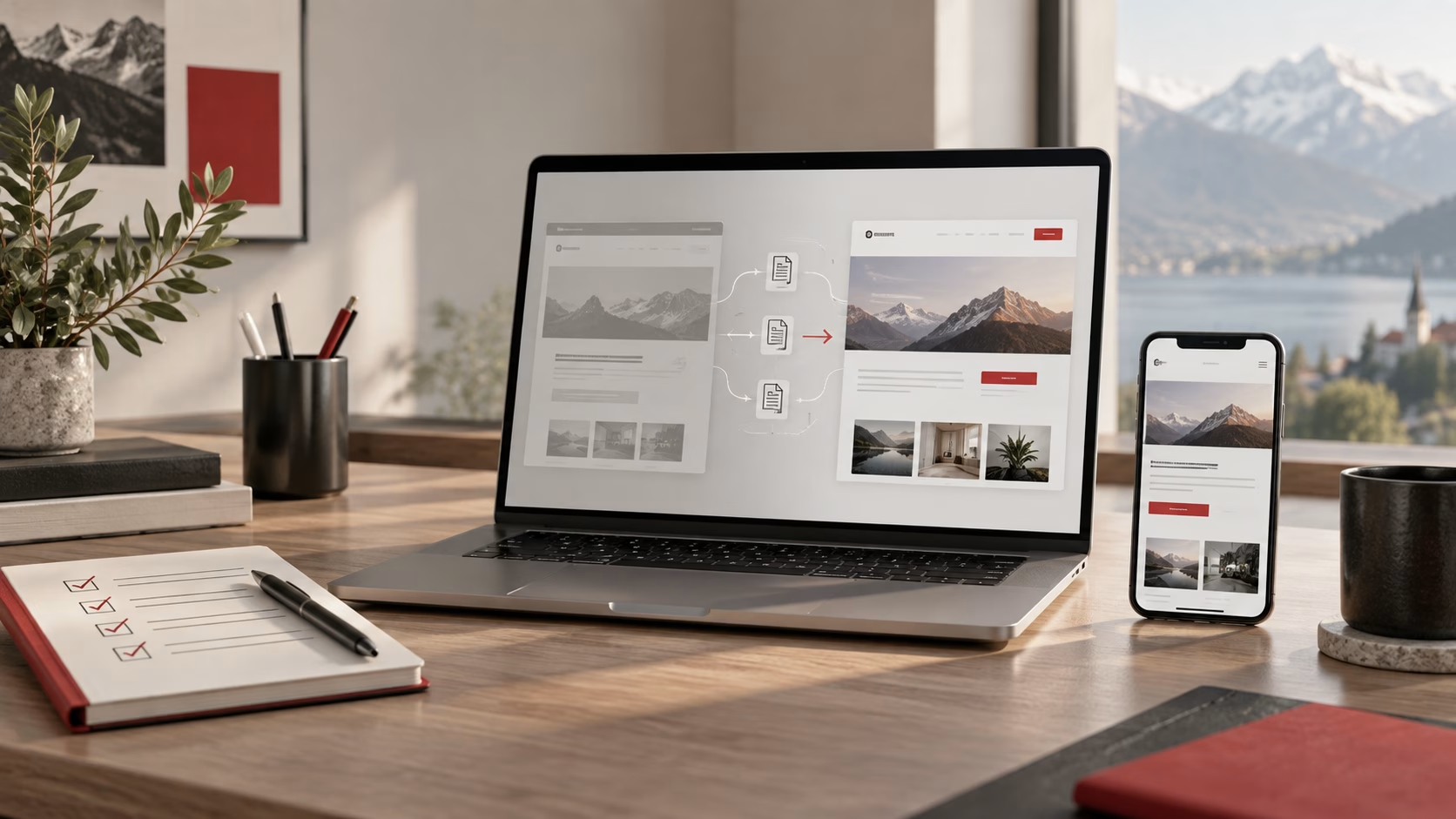
Redesigning a website can improve its image, usability and ability to generate enquiries. However, when a migration is treated only as a visual project, a business may lose URLs already known by Google, links acquired over time, pages generating impressions and data that supports better decisions. An effective redesign must protect what already works and improve what limits growth through a controlled process.
This guide explains how to redesign a WordPress website while preserving SEO continuity. It is intended for Swiss companies, professionals and local businesses that want a modern website without starting from zero in organic search.
Should you redesign the website or improve the existing one?
A website should not automatically be rebuilt simply because it is a few years old. The first step is a technical and commercial assessment covering performance, maintainability, security, page structure, content quality, mobile compatibility and the ability to turn visits into real enquiries.
If the technical foundation is solid, progressive improvement may be enough. A complete rebuild is more appropriate when the theme or system is difficult to maintain, the design no longer meets the audience’s needs, navigation is confusing or the current structure prevents services and content from developing coherently. The decision should be based on evidence and objectives, not only on visual preference.
Before the redesign: create a snapshot of the current website
The most important phase takes place before any page is changed. Build an inventory of the existing website and identify the assets that already have value. This allows the new project to start from evidence rather than assumptions.
- export the URLs included in the sitemap and those detected by Google Search Console;
- identify pages with clicks, impressions, external links or enquiries;
- record titles, meta descriptions, canonicals, hreflang and indexing status;
- map menus, internal links, forms, downloads and conversion buttons;
- check all language versions and the relationships between Italian and English;
- save a copy of the website and measurement data before launch.
This initial snapshot becomes the benchmark for verifying that important pages and functions remain available and properly connected after publication.
Preserve URLs that already have value
When a page keeps the same topic and satisfies the same search intent, preserving its URL is often the safest choice. Changing an address merely to make it shorter or more attractive does not automatically create an SEO advantage. It does, however, introduce redirects, additional checks and a period in which search engines must process the change.
URLs should be changed for a real reason: a new information architecture, merged content, incorrect naming or a substantial change in the service. Even then, the decision should be supported by an exact map from every old address to its new destination.
When permanent redirects are required
If a URL changes, the old address should point directly to the equivalent new page using a server-side permanent redirect, normally a 301 or 308. The relationship should be one to one: a service page should lead to the new content about that service, not generically to the homepage.
Avoid redirect chains, update internal links so they point directly to the final destination and keep redirects in place for at least one year, and preferably longer when technically practical. If content is removed and no genuinely equivalent replacement exists, an intentional 404 or 410 response may be more accurate than a misleading redirect.
The official Google Search Central guidance for site moves with URL changes highlights the importance of URL mapping, permanent redirects and post-launch monitoring.
Canonicals, hreflang and sitemaps: maintaining technical continuity
Every indexable new page should normally declare a consistent self-referencing canonical, unless a specific alternative has been deliberately chosen. On multilingual websites, Italian and English pages should be connected through correct hreflang annotations. Each translation needs its own URL, consistent language and content adapted for the intended audience.
The sitemap should contain only canonical, indexable URLs returning a successful response. Technical pages, internal search results, account areas, duplicated versions and parameter-based URLs should not enter the main sitemap. After the migration, submit the updated sitemap in Search Console and verify that Google is progressively processing the new structure.
Improve content without deleting what Google already understands
A redesign is also an opportunity to make content clearer, more authoritative and more useful. This does not mean automatically replacing every paragraph. Sections that satisfy real user searches, generate impressions or describe a service accurately should be preserved and improved.
E-E-A-T quality comes from specificity: explain who performs the work, which problems are addressed, what process is followed and what real evidence is available. Case studies, technologies used, responsibilities, verifiable examples and company details provide far more value than generic paragraphs added simply to increase word count.
Every project is assessed according to its objectives, structure, languages, content and required integrations. The content plan and depth of each page should therefore reflect the company’s real situation.
Staging, noindex and pre-launch checks
The new website should be developed in a protected staging environment. Preventing the staging site from being indexed is correct, but every temporary restriction must be removed at launch. A noindex setting left active, an overly broad robots.txt rule or an access protection that was not disabled can make even a well-built website invisible to search engines.
Before launch, check at least:
- desktop, tablet and mobile navigation;
- contact forms and confirmation messages;
- telephone, email and WhatsApp buttons;
- redirects, canonicals, hreflang and sitemaps;
- the absence of unintended noindex directives or crawl blocks;
- 404 and 5xx response codes;
- cookie consent, privacy and correct tag activation;
- performance, image delivery and visual stability.
Measure enquiries, not only visits
A business website should not be judged solely by traffic. To understand whether a redesign creates value, measure actions that can become commercial opportunities: form submissions, clicks on telephone numbers, WhatsApp conversations, quote requests and other important steps in the customer journey.
GA4 and Google Tag Manager can record these events, provided that the setup respects consent choices and is tested before and after publication. Comparisons between the periods before and after launch should also consider seasonality, advertising campaigns and changes in the offer. A timing correlation does not automatically prove that every change was caused by the new website.
Essential launch-day checklist
- Create and verify a backup of the previous website.
- Check the old URL → new URL mapping.
- Verify that priority pages return a 200 status.
- Test redirects for chains and irrelevant destinations.
- Check canonicals, hreflang, titles and meta descriptions.
- Remove temporary noindex blocks and update robots.txt.
- Publish and resubmit the correct sitemap.
- Test forms, calls, WhatsApp and quote requests.
- Verify GA4, Tag Manager and conversion events.
- Check mobile usability, performance and the HTTPS certificate.
After publication: what to check in Search Console
During the following days and weeks, monitor indexing, crawl errors, excluded pages, the sitemap and organic performance. URL Inspection helps to verify selected priority pages, while reports for clicks, impressions, CTR and average position show how Google is processing the website.
Temporary fluctuations can be normal during a migration. It is better to verify the data and identify the cause before applying continuous corrective changes. Unexpected 404 errors, 5xx responses, incorrect redirects or important excluded pages require faster and properly documented action.
Common mistakes that can reduce visibility
- changing every URL without a concrete reason;
- redirecting many different pages to the homepage;
- leaving the staging noindex setting active;
- removing content that already generated impressions or links;
- forgetting the relationships between Italian and English pages;
- publishing generic content without real experience or evidence;
- changing the domain, CMS, structure and content simultaneously without separate controls;
- failing to measure forms, calls and other conversions;
- not monitoring Search Console and technical logs after launch.
An SEO-conscious redesign is a continuity project
The new design is what visitors see, but the project’s value also depends on everything preserved and measured behind the scenes. URLs, content, technical signals, language versions and conversions should be treated as parts of the same system.
Swiss Web Studio manages professional website design and redesign projects with technical SEO and Google optimisation integrated from the beginning. Where appropriate, the work also includes WordPress hosting and maintenance, monitoring and operational continuity.
If you are considering a redesign, you can request a project assessment. Ivo Protrkic will review the current website, objectives, languages, content and required integrations before defining the right process.
Frequently asked questions
Should the same URLs always be preserved?
No, but keeping them reduces complexity when the content and intent remain equivalent. If a URL must change, it needs a relevant destination and a direct permanent redirect.
How long does it take for rankings to stabilise?
There is no fixed period. It depends on the size of the website, crawl frequency, technical quality, the extent of the changes and how Google processes the pages. This is why ongoing monitoring is more useful than promising a universal deadline.
Can hosting be changed without changing the URLs?
Yes. An infrastructure migration can keep the domain and addresses unchanged, but it requires checks covering DNS, HTTPS, server configuration, performance, availability and analytics.
Should SEO and redesign be handled within the same project?
Ideally, yes. Involving SEO before the structure and content are finalised helps protect existing signals, avoid late corrections and establish more reliable measurement of results.
Primary technical sources: official Google Search Central documentation covering site migrations, redirects and monitoring through Search Console.